
In This Issue
| NICE reverses its advice on varicocele surgery for fertility | |
| The UK approves its first targeted prostate screening | |
| Polaris and Compass — and a favour to ask | |
| New guide: sperm DNA fragmentation testing | |
| The PIF TICK has been renewed |
Clinical Alert
NICE Has Changed Its Mind About Varicocele Surgery
For thirteen years I have had a version of the same conversation. A man comes in with a varicocele and a poor semen analysis, he has read that surgery might help, and I have had to explain that the national guideline said otherwise — that NICE, in 2013, advised against offering varicocele surgery as a fertility treatment because it did not appear to improve pregnancy rates. In March 2026 that advice was replaced.
What the new recommendation actually says
NICE guideline NG257 now says clinicians should consider radiological or surgical treatment where three things are all true: the varicocele can be felt on physical examination, the couple are trying to conceive naturally, and the semen parameters are reduced. Female fertility factors are weighed in the same decision.
Those three conditions matter. A varicocele seen only on a scan, with no fertility problem and a normal semen analysis, is not what this recommendation is about.
I want to be careful about how much I claim here. The word NICE chose is consider, not offer — in guideline language that is a door opening, not a recommendation to operate. And in the same document the committee asked for new research into how effective these treatments actually are, which is an unusually candid way of saying the evidence is still not settled. What has changed is that surgery is now a legitimate conversation to have. It is not a conclusion.
Read my varicocele guide → The NICE recommendation →Clinical Alert
The UK Now Has a Prostate Screening Programme — For a Very Small Group
This one has been widely reported, and much of the reporting has been looser than the decision itself. At its March 2026 meeting the UK National Screening Committee recommended targeted PSA screening for the first time, and the government accepted the recommendation in June. Roll-out in England begins in 2027. It is worth being precise about who it covers, because a great many people have read the headline and concluded it covers them.
Men aged 45 to 61, with a BRCA2 change and a family history
PSA testing every two years for men in that age band who carry a pathogenic BRCA2 gene variant and have a family history of breast, ovarian, pancreatic or prostate cancer. Both conditions, not either.
It does not currently include Black men, or men with a family history alone — two groups at recognised higher risk. The committee acknowledged that this remains contested, and I think the campaigners pressing on it have a fair point.
If prostate cancer is on your mind and you fall outside that group, nothing here changes what was already true: a PSA test remains available to you, and whether to have one is a personal decision made with someone who can put the result in context. Talk to your GP, or to me.
Read the committee minutes →Service Update
Polaris and Compass — And a Favour to Ask
Last month I introduced the two companion tools: Polaris, which walks with you before treatment while you are still weighing options, and Compass, which walks with you through recovery afterwards. Both remain free for my own patients, and the roll-out is continuing.
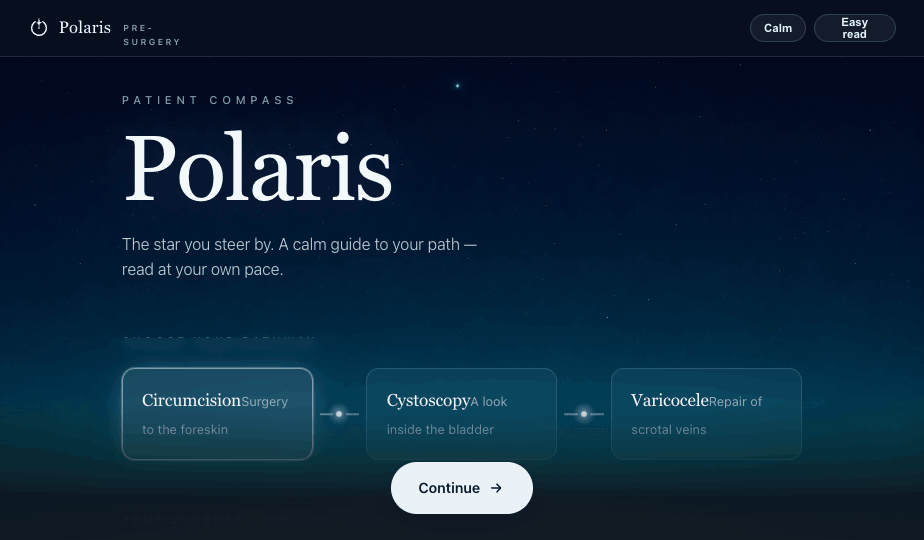
We’re also working on getting Polaris and Compass onto Google Play and the App Store — both submissions are with the review teams now. I’ll confirm here the moment either goes live.
If you have used either one, I would like to hear how it went
There is a short questionnaire — a few minutes, no clinical questions, nothing about your own treatment. It asks what was useful, what was confusing, and what was missing. I read the answers myself and they are what will shape the next version.
If you have not used either tool, you can safely ignore this — there is nothing to report and nothing you are missing.
Tell us how it went →New Guide
“I’ve Had a Sperm DNA Fragmentation Test — What Do I Do With It?”
More and more couples arrive having already bought this test privately, holding a number, and nobody has explained to them what it is meant to change. So I have written a guide that takes the harder question seriously: not just what the test measures, but whether the result should alter anything about your care. Worth knowing before you spend anything: NICE’s 2026 guidance is explicit that supplements, antioxidants and medical treatments should not be offered to improve sperm DNA integrity.
Read the guide →Announcement
The PIF TICK Has Been Renewed
This mark does not renew itself. Every year, an independent assessor goes through how the health information on this website is written, sourced, reviewed and dated, and decides whether it still meets the standard. This year, after that scrutiny, the method I use for medical education and communication was accredited again with the PIF TICK — the UK’s quality mark for trustworthy health information.
It is not a judgement on my clinical work. It is a check on the information itself — whether what you read here is accurate, current, and honest about its own limits. Given how much health information you are handed with no provenance at all, I think that check is worth having, and worth passing again.

Where you see this mark on a page, that page has been through the formal PIF TICK assessment. Find out what that involves →
Everything above is educational information about published guidance. It is not medical advice, and it cannot account for your own history. Decisions about your care should be made with a clinician who knows it.
Need to Talk?
Two guidelines changed this month, and if either has left you wondering whether it applies to you — or if you have been putting off a conversation for longer than that — I’m here.
